A major earthquake that struck portions of the Davao region triggered an extensive military-led disaster response, with the 10th Infantry (Agila) Division deploying aviation assets, ground troops, and inter-agency coordination teams to assess damage and deliver aid to communities in Jose Abad Santos, Sarangani, and Balut Island in Davao Occidental as of June 9, 2026.
Commanding General Leads Aerial Damage Assessment
Major General Alvin Luzon, Commander of the 10th Infantry (Agila) Division, personally led an aerial Rapid Damage Assessment and Needs Analysis (RDANA) on June 9, 2026, surveying earthquake-affected communities in Jose Abad Santos and Balut Island in Sarangani, Davao Occidental. The aerial survey was designed to provide military commanders and government agencies with an accurate, real-time picture of conditions on the ground — particularly in areas where land access had been rendered difficult or impossible by the disaster.
According to the 10th Infantry Division’s Public Affairs Office, the RDANA was carried out jointly with representatives from the Office of Civil Defense (OCD), the Department of Social Welfare and Development (DSWD), the Provincial Disaster Risk Reduction and Management Office (PDRRMO) of Davao Occidental, and local government units (LGUs). The multi-agency composition of the assessment team was intended to ensure that both military and civilian relief priorities were captured in the findings.
Balut Island, due to its geographic isolation, presented particular logistical challenges. Road conditions and the island’s remoteness added significant complexity to ground-based relief operations, making aerial surveys and airlift operations essential tools in the early phase of the response.
Philippine Air Force Black Hawk Conducts Emergency Evacuation
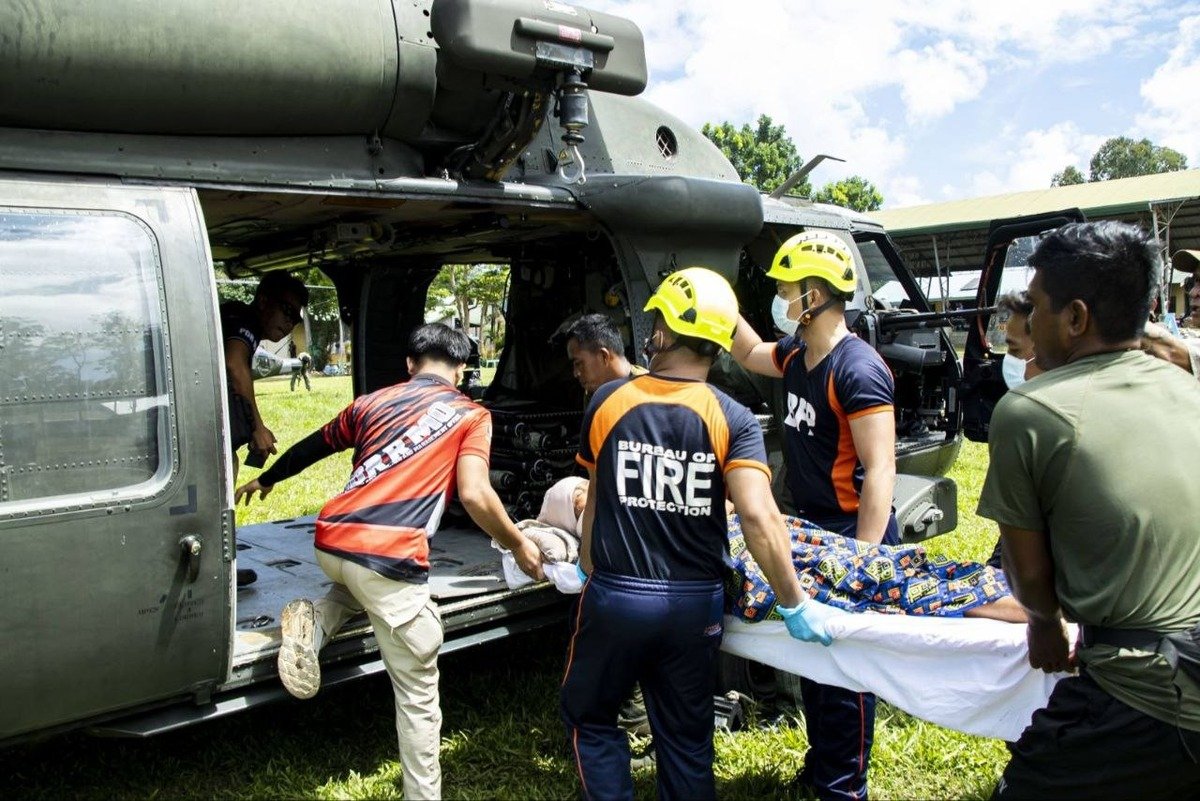
One of the most critical operations carried out on June 9 was an air casualty evacuation (CASEVAC) mission involving a Philippine Air Force Black Hawk helicopter. The aircraft transported four earthquake survivors from Balut Island to medical facilities on the mainland, a measure made necessary by the near-total inaccessibility of the island following the tremor.
The 10ID Public Affairs Office confirmed that the use of military aviation assets reflected the severity of conditions on Balut Island, where conventional land-based evacuation routes remain unavailable. The operation demonstrated the military’s capacity to reach isolated populations quickly when standard emergency services cannot be deployed by land.
The CASEVAC mission is part of a broader pattern of helicopter-supported operations in the area, with aerial assets serving both a reconnaissance and a humanitarian evacuation role in the ongoing response effort.
Ground Troops Deployed for Search, Rescue, and Route Clearing
Beyond the aerial component, Agila Troopers have been conducting sustained ground operations in earthquake-affected barangays since the disaster struck. These activities include search and rescue missions, damage assessment, route clearing to restore access to isolated communities, and direct logistical support to LGUs and partner government agencies.
The 10ID Public Affairs Office stated that additional troops were deployed specifically to severely affected areas in Davao Occidental where roads remain impassable. The deployment was aimed at ensuring that humanitarian assistance — including food, water, and medical support — continues to reach residents who have been cut off from normal supply and emergency service routes.
Troops are operating alongside civilian authorities, pooling both manpower and material resources to accelerate relief delivery. The coordination model places military personnel in direct support of local government units, with civilian agencies retaining the lead on welfare and social services while the military provides logistical backbone and access capabilities.
General Luzon Underlines Importance of Unified Response
During the inter-agency aerial assessment, Major General Luzon addressed the assembled teams and emphasized the centrality of coordinated, multi-stakeholder action in managing the ongoing disaster response.
“Our priority is the safety and well-being of communities affected by this earthquake. Through close coordination with government agencies and local government units, we will continue to provide assistance, support ongoing response efforts, and help communities recover from its effects. We have also deployed additional Agila Troopers to severely affected barangays in Davao Occidental, particularly in areas where roads remain impassable, to ensure that assistance reaches those who need it most,” General Luzon said, as quoted by the 10ID Public Affairs Office.
His remarks reflect the 10th Infantry Division’s operational doctrine of treating inter-agency cooperation as a foundational element of disaster response — especially in geographically complex environments such as island communities and mountainous interior zones, where institutional silos can directly slow down aid delivery.
Division Maintains Sustained Operational Presence
The 10th Infantry (Agila) Division is headquartered at Camp General Manuel T. Yan Sr. in Mawab, Davao de Oro, and holds responsibility for military operations across a significant portion of Mindanao. The Division’s Humanitarian Assistance and Disaster Response (HADR) mandate is regularly activated during natural calamities in the region, and its current operations represent one of the most active disaster response deployments in the country as of the reporting date.
In a statement attributed to Major Ruben L. Gadut, Officer-in-Charge and Chief of the Division Public Affairs Office, the 10ID confirmed full commitment to supporting the government-led disaster response and recovery effort for the duration of the emergency. Major Gadut’s statement indicated that the division’s operations would continue to be sustained until affected communities are stabilized and civilian-led recovery mechanisms are fully in place.
The division is currently running its HADR operations in parallel with its standing security and community engagement functions, with Agila Troopers serving simultaneously as first responders, damage assessors, route clearers, and a stabilizing presence in communities working through the immediate aftermath of the earthquake.
Whole-of-Military Approach Expected to Continue
As of June 9, 2026, active operations across multiple fronts — including search and rescue, casualty evacuation, route clearing, damage assessment, and logistical support to civilian authorities — remain ongoing, according to the 10ID Public Affairs Office. The scale and pace of operations are expected to be maintained in the days ahead as needs assessments are finalized and relief priorities are formally established.
The involvement of both Philippine Army ground units and Philippine Air Force aviation assets in the response illustrates a whole-of-military approach, with different service branches contributing complementary capabilities to reach affected populations across difficult terrain and isolated island communities.
The OCD, DSWD, and local PDRRMO units remain embedded within the military-led operations, ensuring alignment between civilian welfare priorities and ground-level operational realities. The 10ID Public Affairs Office indicated that further situation updates would be released as conditions develop in Jose Abad Santos, Balut Island, and other affected communities across Davao Occidental and surrounding areas.
Photo credit: Photo courtesy of 10th Infantry Division, Philippine Army / Public Affairs Office
Source: 10th Infantry Division Public Affairs Office / Philippine Army
Related stories